Published August 6, 2026 · By Harmony Landscape Design
Every year, we design hundreds of backyards, front yards, and full outdoor spaces for homeowners across Los Angeles, Palm Springs, Palm Desert, Irvine, Scottsdale, and Henderson. That gives us a front-row seat to what people actually ask for — not just what trend forecasters predict.
For this report, we analyzed our own 2026 client design requests to identify the outdoor features, materials, and planning tools homeowners are prioritizing this year. We combined that internal data with the latest published research from Houzz, the National Association of Landscape Professionals (NALP), and the EPA’s WaterSense program to see how our client base compares to national trends — and where the Southwest stands apart.
Here’s what the data shows.
Key Findings at a Glance
- Fire features and pergolas are the top hardscape requests in our 2026 client projects, continuing a multi-year shift toward outdoor spaces designed for year-round use.
- Minimalist, drought-tolerant planting is now the default starting point for design conversations in our desert markets, not an upgrade homeowners have to be talked into.
- Requests for 3D-rendered designs before construction are up significantly, as homeowners look to lock in a budget before committing to a contractor.
- Nationally, the share of homeowners on Houzz replacing their original lawn with natural grass has dropped to 63%, down 9 percentage points since 2024, according to the 2026 U.S. Houzz Outdoor Trends Study — a trend that shows up even more sharply in our Southwest client data.
- Homeowners motivated by improving resale value fell to 15% in 2026, down from 18% in 2024, while those renovating to make their space more livable rose to 25%, per the same Houzz research — outdoor spaces are being designed for daily life, not just a future sale.
- Trend 1: Fire Pits and Fire Features Lead Hardscape Requests
- Trend 2: Pergolas and Shade Structures
- Trend 3: Minimalist, Drought-Tolerant Planting
- Trend 4: Rising Demand for 3D Visualization Before Building
- The Southwest Regional Angle: How Coastal and Desert Markets Differ
- Cost and ROI: What the Data Says About Return on Outdoor Investment
- What This Means If You’re Planning a 2026 Outdoor Project
- Frequently Asked Questions
Trend 1: Fire Pits and Fire Features Lead Hardscape Requests
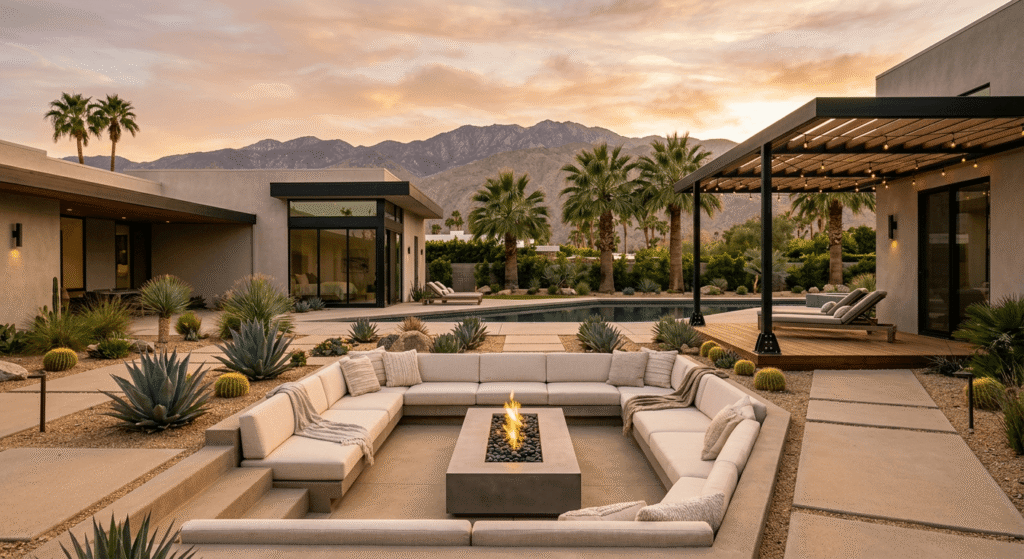
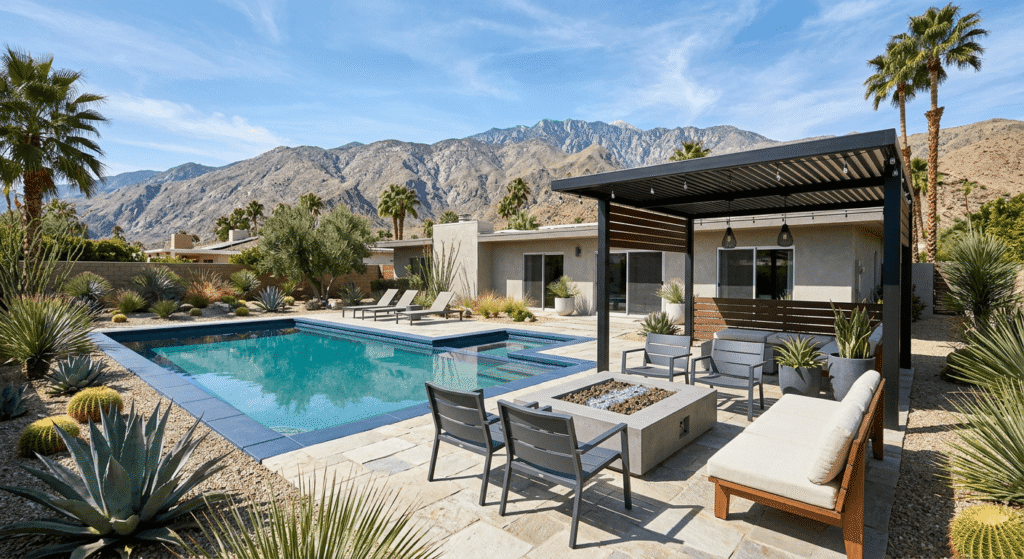
Fire pits and built-in fire features were the single most requested hardscape element across our 2026 client projects — from simple gas fire bowls in Irvine courtyards to full outdoor fireplaces in Scottsdale backyards designed for cool desert evenings.
This tracks with what we’re hearing across the industry. According to the National Association of Landscape Professionals’ 2026 trend report, homeowners are focusing on features that provide long-term value and low maintenance — durable natural materials, efficient irrigation, and multi-functional outdoor spaces — and a fire feature checks nearly every one of those boxes: it extends usable outdoor time into the evening and into cooler months, requires little upkeep, and works as a focal point for a wide range of design styles.
What it costs: A basic pre-fabricated fire pit typically starts in the low thousands, while a custom-built, gas-line-connected fire feature integrated into a patio or seating wall can run significantly higher depending on materials and site work. Because it adds usable living space rather than just an amenity, it’s one of the more cost-effective ways to expand a backyard’s function without expanding its footprint.
Trend 2: Pergolas and Shade Structures
Shade is no longer an afterthought — it’s a design requirement, especially across our desert markets. Pergolas, shade sails, and louvered patio covers appeared in a large share of our 2026 backyard and full-yard design requests, often as the anchor structure around which the rest of the layout is planned.
This aligns with national data from Houzz: lounge or seating areas are now the most common outdoor living space, included by more than four in five renovating homeowners, followed by dining areas. Both of those zones depend on shade to be usable through the hottest parts of the day — which is exactly why we’re seeing pergola requests climb fastest in Palm Springs, Palm Desert, and Scottsdale, where outdoor living season runs longer but summer heat is more extreme.
What it costs: Pergola pricing varies widely based on material (wood, vinyl, or aluminum) and whether it includes a retractable canopy or louvered roof system. Homeowners who add a pergola over an existing patio typically see the fastest return, since it converts underused square footage into a shaded living space without a full hardscape rebuild.
Trend 3: Minimalist, Drought-Tolerant Planting
Across our Southern California and Arizona projects, minimalist planting palettes — clean lines, structural plants, gravel and decomposed granite groundcover, and native or adapted species — have become the starting point for design conversations rather than a cost-saving compromise.
This mirrors what’s happening industry-wide. According to the National Association of Landscape Professionals’ 2026 plant trends report, client plant preferences are increasingly driven by tolerance for maintenance, climate realities, and how homeowners want to use their outdoor spaces, with demand for drought-tolerant and native varieties rising fastest in regions facing water restrictions — a description that fits nearly every market we serve.
The EPA’s WaterSense program backs up the financial case for this shift. If every home with an automatic sprinkler system in the U.S. properly used a WaterSense labeled irrigation controller, the country could save up to $4.5 billion in water costs and 390 billion gallons of water annually from not overwatering lawns and landscapes. At the individual household level, a WaterSense labeled irrigation controller can reduce a home’s irrigation water use by up to 30 percent and save up to 15,000 gallons of water annually compared to a standard clock-based controller — savings that compound quickly in Palm Desert, Scottsdale, and Henderson, where irrigation makes up a large share of a home’s total water use.
For homeowners weighing turf removal, our related guide on modern drought-tolerant landscaping ideas breaks down design approaches that stay lush and layered without relying on thirsty lawns.
Trend 4: Rising Demand for 3D Visualization Before Building
One of the clearest shifts in our own data: homeowners are asking to see a fully rendered 3D design before they’ll approve a project or bring in a contractor for pricing. This isn’t unique to design-forward clients anymore — it’s becoming the standard expectation across nearly every package tier we offer.
The reason is straightforward. Landscaping is expensive to change once it’s built, and homeowners increasingly want cost certainty upfront rather than mid-project surprises. A detailed 3D render lets a homeowner see plant placement, hardscape materials, and structure scale before a single yard of concrete is poured — which is exactly why it’s become a standard part of our own design process, from the initial questionnaire through final plans.
The Southwest Regional Angle: How Coastal and Desert Markets Differ
National trend reports are useful, but they tend to flatten real regional differences — and our client data shows those differences clearly across the six markets we serve.
Coastal Southern California (Los Angeles, Irvine): Requests lean toward multi-zone backyards that balance lounge, dining, and play space, with planting palettes that mix drought-tolerant structure plants with pockets of lusher greenery. Shade structures are popular but often secondary to layout and flow.
Desert Southwest (Palm Springs, Palm Desert, Scottsdale): Shade and fire features are non-negotiable rather than optional upgrades, given the intensity of both summer heat and desert evenings. Minimalist, native, and low-water planting isn’t a trend here — it’s close to the default. We also see a higher share of clients requesting full irrigation redesigns alongside their landscape plan.
Henderson, NV: Sits between the two, with strong demand for drought-tolerant planting paired with more traditional outdoor living layouts — patios, pergolas, and defined entertaining zones.
This regional split is a big part of why a national “top trends” list often misses the mark for homeowners in our service areas — the right design decision in Irvine isn’t always the right one in Scottsdale, even when the underlying trend (say, minimalist planting) is the same.
Cost and ROI: What the Data Says About Return on Outdoor Investment
Homeowners consistently ask us whether a given outdoor feature is “worth it,” and the data is generally encouraging. A standard lawn care service on 5,000 square feet of lawn had an estimated cost recovery of 217%, according to the Remodeling Impact Report: Outdoor Features, a joint study from the National Association of Realtors and the National Association of Landscape Professionals — among the highest returns of any home improvement category tracked, outdoor or indoor.
Individual feature ROI varies by market and execution quality, but a few patterns hold consistently across our projects:
- Lower-cost, high-visibility upgrades (defined planting beds, walkways, lighting) tend to return a high percentage of their cost because they immediately improve curb appeal and day-to-day livability.
- Mid-range features (fire pits, pergolas, expanded patios) return well because they add functional living space rather than just decoration — buyers and appraisers increasingly view a well-designed backyard as usable square footage.
- Water-wise conversions (turf replacement, drip irrigation, native planting) return value two ways: increased curb appeal and lower ongoing water costs, which matters increasingly to buyers in drought-prone Southwest markets.
For a deeper look at how landscaping investment translates into home value, see our related guide: Does Landscaping Increase Home Value? A 2026 Guide for Homeowners.
What This Means If You’re Planning a 2026 Outdoor Project
If you’re weighing a backyard, front yard, or full-yard redesign this year, the data points to a few practical takeaways:
- Plan for shade and fire from the start. These aren’t add-ons anymore — they shape the whole layout, so it’s worth designing around them rather than fitting them in later.
- Default to low-water planting, especially in desert markets. It’s no longer a compromise on style; some of the most striking modern designs we produce are built entirely around drought-tolerant palettes.
- See your design in 3D before you commit to pricing. It’s the single best way to avoid budget surprises once construction starts.
- Design regionally, not generically. What works in a coastal LA backyard often needs real adjustment for Palm Desert or Scottsdale heat and water conditions.
If you’d like a custom 3D design built around your own yard, budget, and region, you can start your free consultation or explore our backyard design, full yard design, and Ultimate Design packages to see which fits your project.
Frequently Asked Questions
What Are the Biggest Outdoor Design Trends for 2026?
Based on our 2026 client data, the leading trends are fire pits and fire features, pergolas and shade structures, minimalist and drought-tolerant planting, and a sharp rise in demand for 3D-rendered designs before construction begins.
Are Drought-Tolerant Landscapes Only Popular in Desert Climates?
No. While demand is highest in desert Southwest markets like Palm Springs, Palm Desert, and Scottsdale, drought-tolerant and native planting is growing quickly in coastal markets too, driven by both water costs and a preference for lower-maintenance yards.
Does a Fire Pit or Pergola Actually Increase Home Value?
Features that add usable outdoor living space, like fire pits and pergolas, tend to perform well because they function as additional square footage rather than pure decoration. Overall landscaping investment has one of the strongest cost-recovery rates of any home improvement category.
Why Are More Homeowners Requesting 3D Designs Before Building?
3D visualization lets homeowners see plant placement, materials, and structure scale before committing to a contractor, reducing the risk of costly mid-project changes. It’s become a standard part of the design process for most of our 2026 clients.
Where Does This Report’s Data Come From?
This report is based on Harmony Landscape Design’s own 2026 client project data across Los Angeles, Palm Springs, Palm Desert, Irvine, Scottsdale, and Henderson, supplemented by published research from Houzz, the National Association of Landscape Professionals, and the EPA’s WaterSense program.
Ready to bring your own 2026 outdoor design to life? Start your free consultation and get a custom 3D design in as little as two weeks.